Open-source · open-hardware · amateur radio astronomy · Chile

A home-built radio telescope that listens to the Milky Way's hydrogen

Antenna Listening Mostly to Interference, Tentatively Astronomy

ALMITA observes the 21 cm line of neutral hydrogen at 1420.405752 MHz with an RTL-SDR, a modified grid dish and an equatorial mount. Its own software plans a sky mosaic, points, captures raw I/Q, reduces it to spectra and turns them into velocity maps - all from a web console that works offline, in a field.

1420.4 MHz
the hydrogen line, rest frequency 1420.405752 MHz
20°
beam of the ~90 × 60 cm grid dish with a DIY dipole feed
≈120 K
system temperature from a Y-factor of 4.71 dB (12 Nov 2026)
±0.6 MHz
frequency switching: the receiver's shape cancels, the line stays
5 Nov 2026
first hydrogen seen, matching the HI4PI survey's shape
How it works

From a dish on a rooftop to a velocity map

The signal path is short and cheap; most of the work is in software that keeps every step auditable: raw data are kept, every product says how it was made, and nothing claims a calibration it does not have.

AntennaGrid dish + dipole

Pawsey balun, reflector plate, 20° beam

ReceiverLNA + RTL-SDR

2.4 MS/s raw I/Q around 1420.4 MHz

At the dishRaspberry Pi 4

in a metal box: rtl_tcp, INDI for the OnStep mount

IndoorsNotebook

web console, capture, REDUCE, SCIENCE

OBSERVEplans a grid on the sky, checks it is up and away from the Sun, points the mount and records HDF5 captures with all their metadata.
REDUCEturns each capture into a spectrum: RFI masks, frequency-switch folding, LSRK velocity, and an honest uncertainty per channel.
SCIENCEgrids the spectra with the real beam into velocity cubes and integrated maps, with HI4PI's expected map beside them.
The web console

Every page, what it does

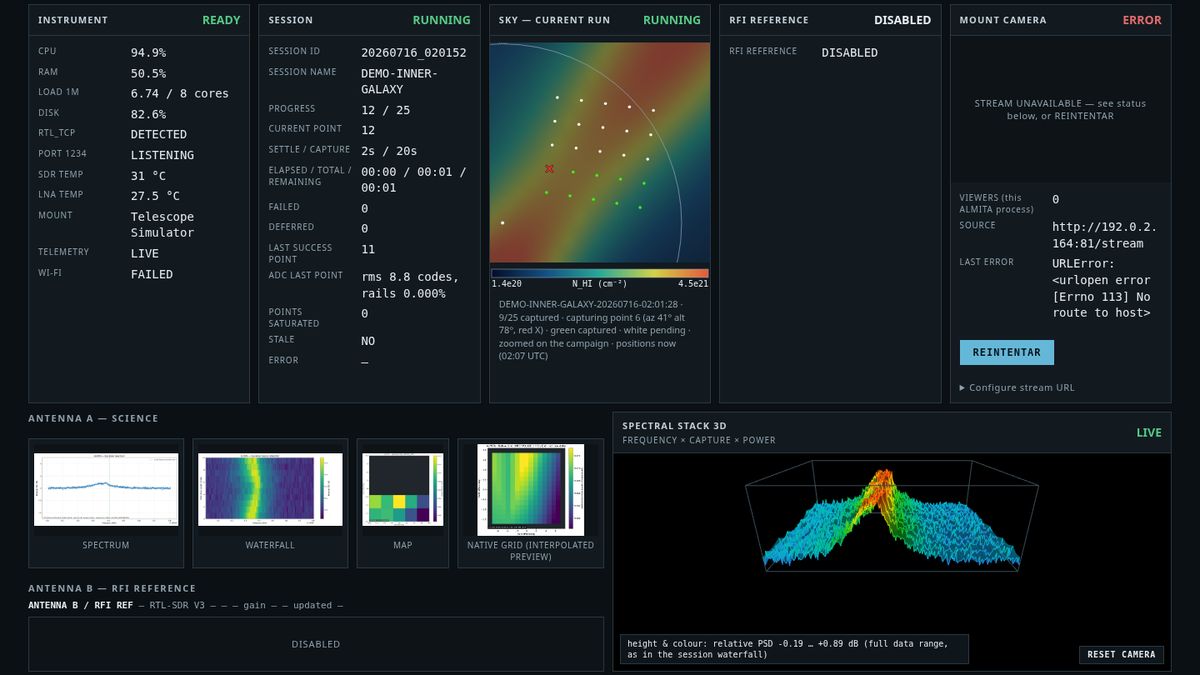
One port, one login, a DAY/NIGHT theme for sunlight, a STOP MOUNT button on every page. These screenshots come from the SIMULATED demo, so the mount is INDI's Telescope Simulator and the sky is HI4PI. Click a picture to enlarge it.

Live demo SIMULATED

Press the buttons yourself

The demo is ALMITA's real console, replaying a recording of its own software driving a simulated telescope and SDR on a simulated winter night in Santiago (15 July 2026, the Galactic Centre overhead). The SDR stand-in streams I/Q whose sky follows the HI4PI survey through ALMITA's 20° beam.

  1. OBSERVE - press PLAN, then START. A 5 × 5 grid near l = 10° runs, ten times faster.
  2. MONITOR - watch spectra, waterfall and the 3D stack arrive point by point.
  3. REDUCE - pick the campaign, PLAN, RUN: 25 / 25 spectra with ESTIMATOR v2.
  4. SCIENCE - PLAN and RUN the maps, next to what HI4PI says they should look like.
  5. EXPERIMENT - start the Chain check recipe and read its pre-written verdict.
  6. STATUS - the sky map now shows the 25 pointings.
MONITOR during the simulated grid: live spectrum, waterfall, map and a 3D spectral stack
MONITOR halfway through the simulated grid. Nothing here is a real observation.
Results so far REAL DATA

What ALMITA has actually seen

Real rooftop nights in Santiago, all re-analysed on 25 November 2026. Every result comes with what it does not show. All intensities are relative: there is no calibration in Kelvin yet.

The Milky Way's rotation19 Nov 2026

An afternoon of the survey pilot running on its own: 99 captures of 2 minutes, none failed, at l = 0°, ±10°, ±20°, ±30°. On one side of the Galactic Centre the hydrogen spreads to positive velocities, on the other to negative ones, and the spread grows away from the centre: the disc rotates. The mean velocity goes from +18 km/s at l = +30° to −19 km/s at l = −30°.

At l = +30° the edge of the line sits at +104 ± 2 km/s whichever threshold is used.

What this is not
  • Not yet a rotation speed: with the usual V0 = 220 km/s, the assumption supplies half of it.
  • One afternoon, one ON/OFF run per direction; the OFFs were 20–40° higher than the ONs.
  • A 20° beam averages a wide stretch of the Galaxy.

Hydrogen with frequency switching, repeated12 Nov 2026

The same 5 × 5 mosaic around l ≈ +20°, now with frequency switching and a new feed. The line shows up in all 25 pointings, on a flat baseline (leftover receiver structure ~0.75 %, against a line of 14–18 %). Inside the HI4PI reference tile its shape correlates +0.95 to +0.99 with HI4PI, and only +0.29 to +0.65 with the velocity axis mirrored.

What this is not
  • Not a pointing-by-pointing match: HI4PI's spectrum of another pointing correlates +0.91 to +0.98.
  • Still relative, not Kelvin.
  • The Magellanic Clouds were not detected.

First 21 cm hydrogen detection5 Nov 2026

The first night on a rooftop: hydrogen where the HI4PI all-sky survey says it should be, on the correct side of zero velocity (the match fails with the axis flipped). Shape correlation with HI4PI +0.37 to +0.51, +0.83 at l = 20°, b = 0.

What this is not
  • Not a calibrated measurement; leftover receiver ripple of ±2–6 %.
  • Hydrogen with the right sign, not a pointing-by-pointing match.

The full results, with every number and caveat, are in the README →

Scientific honesty

Conservative claims, raw data kept

  • Relative, not absolute. No calibration in Kelvin, Jansky or column density is claimed yet.
  • Verdicts before data. EXPERIMENT recipes write what counts as a result before the sky is observed.
  • Null tests. Every match with HI4PI is checked against a mirrored velocity axis and against other pointings.
  • Retractions are published. The November re-analysis withdrew two rotation speeds and a velocity offset, in public.
  • No automated astrophysics. Nothing in the pipeline interprets or classifies signals on its own.
Hardware

Accessible, experimental, repairable

Dish
Modified grid reflector, ~90 × 60 cm; beam ~20°
Feed
DIY 1420 MHz dipole, Pawsey balun, reflector plate
Receiver
Low-noise amplifier + RTL-SDR Blog V3
Mount
Equatorial, OnStep controller, INDI
Computers
Raspberry Pi 4 in a metal box at the dish; a notebook for everything else
Interference
Its own worst enemy was the Raspberry Pi 5 that used to run it: retired for radiating into the feed
Fasteners
Suspiciously many plastic cable ties. Temporary. For quite some time.